Many Chinese people would take chinese herbs during their pregnancy. My families and my husband families are among those who believe that preggars should consume chinese herbs, to strengthen the uterus and thus the well being of the baby.
Consumption of chinese herbs is prohibited by my obgyn (obstetricians and gynaecologists) in Singapore. According to her, herbs do not have any quality control and thus should be avoided as we are unsure of the quality.
At first, I took some of chinese herbs during my pregnancy, and I fell ill. It was just the regular chicken herbs soup that I always took since I was young. I had stomach cramps. At first I thought it was just a coincidence. Then after the next 2 times I took the chinese herbs soup, I am very certain that the stomach cramp is due to the chinese herbs I consumed. It was in my early trimester of pregnancy. I avoided chinese herbs since then, and ignored what my family and my hubby's family said about the importance of consuming chinese herbs.
And I finally find a more detailed explanation in one of pregnancy books I am reading, on why preggars should avoid taking chinese herbs, or any herbal cures in general. So my preggars friends, or if there is any of you who is trying to conceive, note down this piece of information.
Medicinal herbs are drugs, often very powerful ones. Some are so powerful that they are used in laboratories to produce prescription medicines. Others have been used for generations in some societies to induce abortions, and some have been linked to miscarriage.
Even in a seemingly soothing cup of tea, some herbs are capable of producing such symptoms as diarrhea, vomiting, and heart palpitations. The use of herbal medicines presents an added risk that is not present hen the remedies come from the drugstore.
Herbs are not made under quality-controlled conditions, and may be dangerously strong or imptently weak. They may also contain harmful contaminants, including such allergens as insect parts, pollens, and molds, and even toxic agents such as lead or arsenic.
Considering the above, you should also avoid herbal teas. If you are craving for the taste or smell of herbal teas, just add orange, apple, pineapple, lemon, mint leaves, cinnamon, nutmeg, cloves or other spices to your decaffeinated tea.
Monday, November 17, 2008

Thursday, November 13, 2008
Cold Roast Potatoes Cause Hiccups
Do not eat roast potatoes when it is already cold, because it would cause inconvenient hic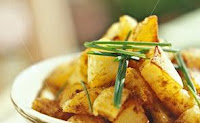 cups to you.
 cups to you.
Hiccups are involuntary contractions of the diaphragm and other inspiratory muscles, that is the muscles we use to breathe in. Hiccups can be a sign of irritation in our body.
Hiccups occur when we eat too much at once and do not chew it properly before swallowing it down.
But there are also many other causes of hiccups. One of them is the resistant starch found in starchy foods like potatoes when eaten cold. Resistant starch resists the process of digestion in the small intestine (where starchy food is digested when it is hot), and moves into the bowel and colon where it is fermented by bacteria. This causes more gas, bloating, irritating our diaphragm and thus causes hiccups.
So if you happen to have roast potatoes leftovers in your fridge, do make sure you heat it up before you eat it.
Monday, November 3, 2008
Plants To Clear The Air In Your Office
Looking for something to freshen up the air in your office?

The plants used in this study are common house plants: Howea forsteriana (Kentia palm); Spathiphyllum wallisii var. Petite (Peace Lily); and Dracaena deremensis var. Janet Craig.
Here is some good news. We may at some relief now, thanks to the research from Plants and Environmental quality Group at the University of Technology in Sydney. Their study has found that plants removed about 70% of Volatile Organic Compounds (VOCs) at concentrations above 100ppb from the office air. Volatile Organic Compounds are emitted from certain types of plastic in chairs, furniture and office appliances. Plant metabolism and soil microorganisms are involved in this clearing the air process.

The plants used in this study are common house plants: Howea forsteriana (Kentia palm); Spathiphyllum wallisii var. Petite (Peace Lily); and Dracaena deremensis var. Janet Craig.
So you might want to start looking for these plants to put in your office, for a safer and clearer air to breathe.
Tuesday, October 28, 2008
Supplements For Depression During Pregnancy
 It is not uncommon for pregnant women to suffer from depression. Sadly, there is not enough available therapy out there that is safe for pregnant mom and the fetus.
A study as published in Journal of Clinical Psychiatry, conducted by Dr. Kuan-Pin Su from China Medical University Hospital, has shown that Omega-3 supplements can ease depression during pregnancy.
However, preggars should watch out for few side effects such as insomnia, nausea, and diarrhea.
Tuesday, October 21, 2008
Fight Against Cancer With Broccoli
 Good news for all of us who like to eat broccoli, well even those of you who do not like it, we all should start taking in more broccoli into our diet.
A study by Institute of Food Research in England has shown that broccoli can affect hundreds of genetic changes. To name a few: to strengthen genes that could fight against cancer, and to eliminate genes that could promote tumor.
Besides having isothiocyanate, broccoli also contain sulforaphane which yield extra immunity to fight against cancer.
Tuesday, October 14, 2008
How Smoking Parents Ruin Their Baby's Health
My husband is a smoker, and this worries me a lot. During my pregnancy, he always manages to smoke outside the house. But most of the time, I can still smell the tobacco after he finished smoking, even after he has brushed his teeth.
Smoking in fact should be avoided at all. Pregnant women should quit smoking to reduce the risk of premature delivery and of having a low-birthweigh baby. The spouse should do the same too, all in the name of the baby.
Studies have shown that smoking by parents has been linked to:
And what seems to be quite safe for the mother or spouse to smoke outside the house, it is totally untrue! Do note that the above risks ARE NOT eliminated even when parents step outside the house to light up. Researchers have found that children in households with smokers who smoke only outside are still exposed to 70% more damaging lung particles than those in nonsmoking households.
So quitting smoking keep your child healthier in their childhood. Quitting obviously will not be easy. As they would with any drug addiction, your body and your mind will align against you. But, if you are determined to fight back, for your sake and your baby's sake, you can triumph over both! The best time to give up is now, before baby is born. So your newborn will come home from hospital to clean, breathable air.
Smoking in fact should be avoided at all. Pregnant women should quit smoking to reduce the risk of premature delivery and of having a low-birthweigh baby. The spouse should do the same too, all in the name of the baby.
Studies have shown that smoking by parents has been linked to:
- an increased risk of SIDS / Sudden Infant Death Syndrome (sudden and unexpected death of an apparently healthy infant that is unexplained by the baby's medical history, and is the major cause of infant death between the ages of 2 weeks and 12 months),
- more respiratory illnesses (colds, flu, bronchiolitis, asthma) and ear infections during the first year of life,
- impaired lung capacity, as well as
- an increased risk of tooth decay later on in childhood.


And what seems to be quite safe for the mother or spouse to smoke outside the house, it is totally untrue! Do note that the above risks ARE NOT eliminated even when parents step outside the house to light up. Researchers have found that children in households with smokers who smoke only outside are still exposed to 70% more damaging lung particles than those in nonsmoking households.
So quitting smoking keep your child healthier in their childhood. Quitting obviously will not be easy. As they would with any drug addiction, your body and your mind will align against you. But, if you are determined to fight back, for your sake and your baby's sake, you can triumph over both! The best time to give up is now, before baby is born. So your newborn will come home from hospital to clean, breathable air.
Thursday, October 2, 2008
Superbug Enemy
 Scientists have discovered the natural antibiotics that can kill 12 types of bacteria that are very resistant to available medicines. Some of the bacteria include Staphylococcus aureus and Escherichia coli.
This antibiotics is made of the secretion of maggots. It needs 20 glasses of maggots to produce 1 drop of the antibiotic.
Subscribe to:
Posts (Atom)


